20 Wonderful Honey Bee Facts (#8 is Surprising)
I think we should get ourselves some honey bee facts, after all so many healing and health-promoting opportunities for the humans begin with this little busy creature. As you read the following 20 interesting honey bee facts, you will be so intrigued just like me by this teensy-weensy fellow's extraordinary abilities.
1. The honey bee has been around for millions of years.
2. Honey bees, scientifically also known as Apis mellifera, which mean "honey-carrying bee", are environmentally friendly and are vital as pollinators.
3. It is the only insect that produces food eaten by man.
4. Honey is the only food that includes all the substances necessary to sustain life, including enzymes, vitamins, minerals, and water; and it's the only food that contains "pinocembrin", an antioxidant associated with improved brain functioning.
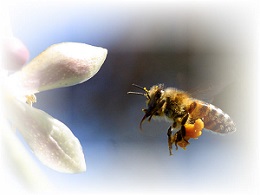
5. Honey bees have 6 legs, 2 compound eyes made up of thousands of tiny lenses (one on each side of the head), 3 simple eyes on the top of the head, 2 pairs of wings, a nectar pouch, and a stomach. See image for: honeybee body parts.
6. Honey bees have 170 odorant receptors, compared with only 62 in fruit flies and 79 in mosquitoes. Their exceptional olfactory abilities include kin recognition signals, social communication within the hive, and odor recognition for finding food. Their sense of smell is so precise that it could differentiate hundreds of different floral varieties and tell whether a flower carried pollen or nectar from metres away.
7. The honey bee's wings stroke incredibly fast, about 200 beats per second, thus making their famous, distinctive buzz. A honey bee can fly for up to six miles, and as fast as 15 miles per hour.
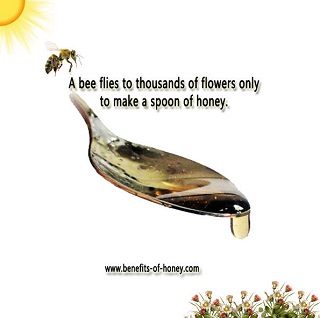
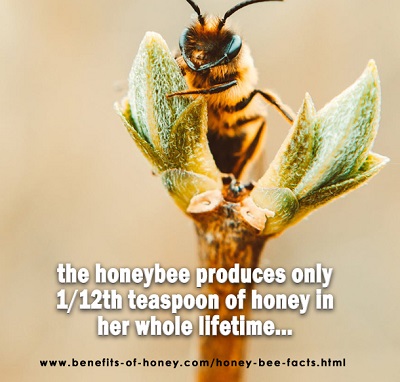
8. The average worker bee produces only about 1/12th teaspoon of honey in her lifetime. Doesn't this fact make you love every drop of honey? Read and you will understand why it makes so much sense to say: "as busy as a bee".
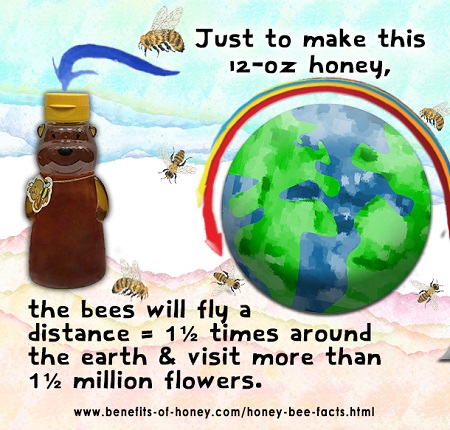
 9. A hive of bees will fly 90,000 miles, the equivalent of three orbits around the earth to collect 1 kg of honey.
10. It takes one ounce of honey to fuel a bee's flight around the world (National Honey Board).
11. A honey bee visits 50 to 100 flowers during a collection trip.
12. The bee's brain is oval in shape and only about the size of a sesame seed (iflscience.com), yet it has remarkable capacity to learn and remember things and is able to make complex calculations on distance travelled and foraging efficiency.
13. A colony of bees consists of 20,000-60,000 honeybees and one queen. Worker honey bees are female, live for about 6 weeks and do all the work.
14. The queen bee can live up to 5 years and it's role is to fill the hive with eggs. She is the busiest in the summer months, when the hive needs to be at its maximum strength, she lays up to 2500 eggs per day. The queen bee has control over whether she lays male or female eggs. If she uses stored sperm to fertilize the egg, the larva that hatches is female. If the egg is left unfertilized, the larva that hatches is male. In other words, female bees inherit genes from their mothers and their fathers while male bees inherit only genes from their mothers. Click here to learn more about the Honey Bee Life Cycle
.15. Larger than the worker bees, the male honey bees (also called drones), have no stinger and do no work at all. All they do is mating. In fact, before winter or when food becomes scarce, female honeybees usually force surviving males out of the nest.
16. Each honey bee colony has a unique odour for members' identification.
17. Only worker bees sting, and only if they feel threatened and they die once they sting. Queens have a stinger, but they don't leave the hive to help defend it. It is estimated that 1100 honey bee stings are required to be fatal.
18. The worker bees produce honeycomb which comprises hexagon shaped cells through the consumption of honey produced from the collected flower nectar. To produce one pound of beeswax, six to eight pounds of honey are ingested
19. Honey bees communicate with one another by dancing. More on their awesome sense of time, communication of distance and direction in "The Awesome Honeybee Dance".
20. During winter, honey bees feed on the honey they collected during the warmer months. They form a tight cluster in their hive to keep the queen and themselves warm.

The more I learnt about honey bee facts; honey's great creator -the honey bee itself, its highly organized society, how it acts with such intricate cooperation, and the various bee products, the more I admire and respect this amazing creature. It is no wonder why sometimes the colony is called a superorganism.
~ Royden Brown
"If the bee disappears from the surface of the earth, man would have no more than four years to live?"
~ Albert Einstein
Other Related Pages
1. Be amazed by how honey bees organize themselves and assume the different roles in the hive. There is every reason why the bees are known a superorganism! More facts of honey bee in: Awesome Roles of Bees in a Hive.
2. As busy as a bee. Are the honeybees really that busy? Do they rest at all? Busy as a bee.
3. Learn more about the honeybees in: Fascinating Honeybee Facts.
4. Do bees poop in the honey they make? Are their droppings smelly when all they eat is honey and pollen? What do honey bees use to make the bee hive? Is it true that the government is using bees to sniff out bombs? Get these answers and fun facts of honey bee in Bee & Honey Questions Answered.
5. Beekeeper Geoff Kipps-Bolton from San Diego believes that "no matter how many books you read..., the bees will retain the right to do something different...They have an infinite capacity to make you look foolish...they don't read the same books! Read full account in An Up-Close Look at the Bees with Geoff the Beekeeper.
6. Pam is from Ohio, North America. Just started keeping bees not too long ago, she was enthusiastic to share about her new found passion - "The more we read about these amazing insects, the more respect I gained for them. I go out to our hives just to watch them come in from foraging and watch the others take flight to get the nectar and pollen." Read full account in Insights into Beekeeping: An Interview with a Beekeeper.
7. There are two extreme species of bees: 1) The Africanized Honey Bee. and 2) The Bumble Bee

8. As you collect more honey bee facts and know more about honey and its benefits, there are specific terms that you would inevitably come across, such as the following:
* Bee Pollen
* Bee Wax
* Beeswax Candles
* Royal Jelly
* Propolis
* Organic Honey
* Mead
9. Know more about facts of honey bee and terms related to the Honey Bees.
10. More interesting facts about honey bees that will wow you, in:
* About Honey Bee - Facts that You Probably Never Knew
* Honeybees are Ultimate Bomb Detectors!
11. Use pictures to teach cool honey bee facts for kids. Your very young readers would love these honey bee facts for preschoolers in Honey Bee Facts For Children
12. What have Winnie the Pooh and the little black rain cloud got to do with the Colony Collapse Disorder?
13. How Marion got into beekeeping after learning about the Colony Collapse Disorder. All in: Marion's Bee Keeping Journey
14. Did Albert Einstein Ever Link Doom of Human Race to Bees?
15. A platform for beekeeping newbies and anyone who has a question about bees or want to know more about bee and beekeeping facts: Tips for New Beekeepers
16. Did you know that there are stingless bees? I finally saw them with my own eyes! All in: Stingless Bees are an Eye Opener
17. Bees and honey in Hong Kong, one of the most urbanised cities in Asia: In Search of Honey and Bees in Hong Kong
18. See the busy bee latched on white flowers taken in a Oolong tea plantation and a tiny bee farm in Taiwan - Busy Bee and Rainy Day.
19. Do bees poop in their honey? And is honey bees' vomit?
20. My wonderful visit to Ee Feng Gu honeybee farm apiary, Malaysia: My Honeybee Farm Visit – Picture Tells 1000 Words.
End of "20 Wonderful Honey Bee Facts (#8 is Surprising)". Back to "How do bees make honey?"